· Guide · Community
Harvest Market: how to run a stall that pays
Harvest Market is the town field's own little game: grow vegetables in the morning, sell them at the market in the afternoon, read the ledger in the evening. Twelve days of it make a season, and a season teaches more about selling than it looks.
How to get there
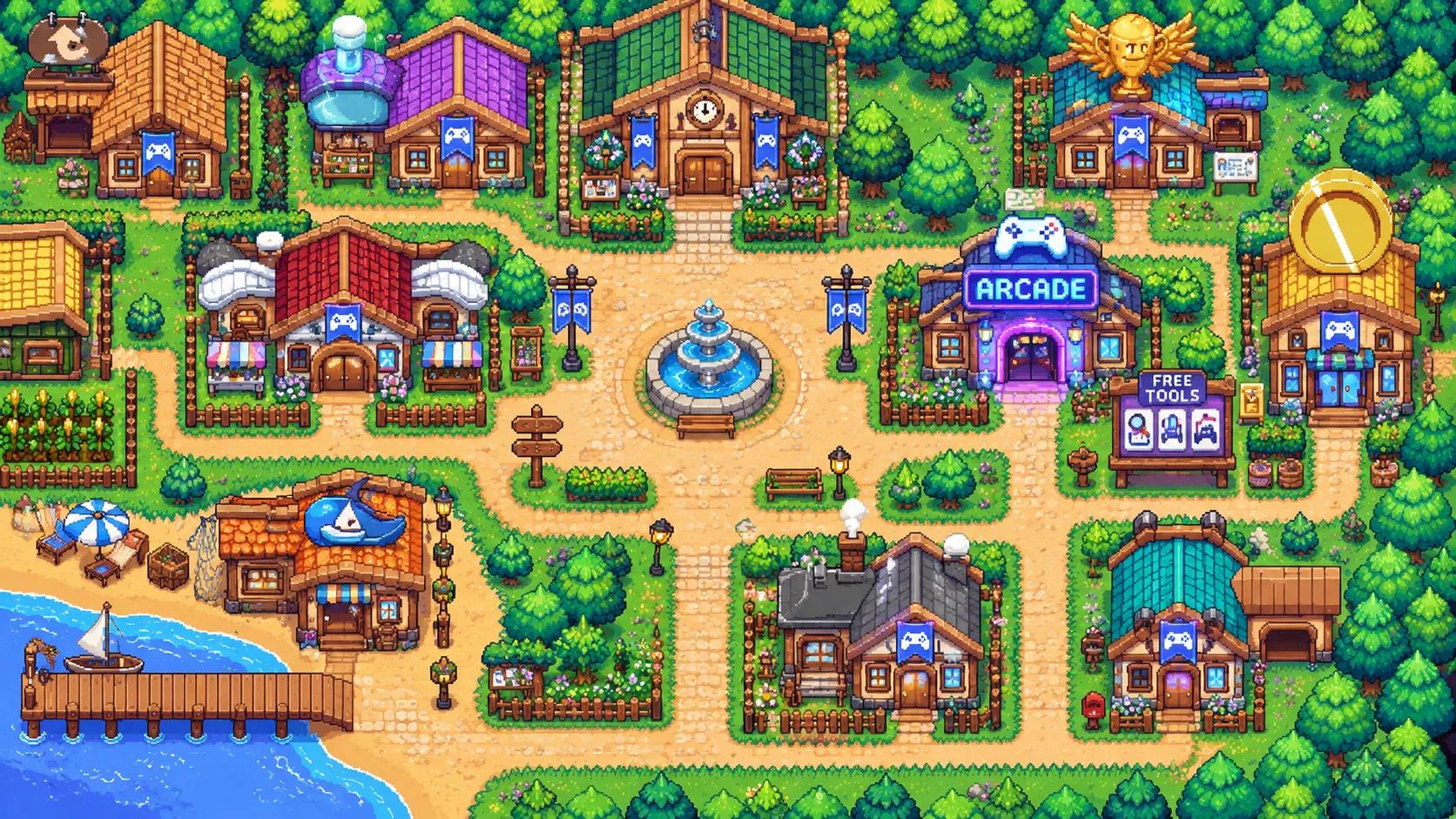
In town, walk to the field beside the yellow house on the west road and step up to it: the town asks if you want to enter. From the Community page's list of places, Harvest field opens it directly.
It is a community place, not a catalogue game: no leaderboard, no Daily, and no SkillXP. Your season is saved in this browser, so you can leave and come back to it.
A day at the market
A season is 12 market days. You start with 60 coins, and the stall's rent is 8 coins every market day, sale or no sale. Ripe plots are picked for you when you head to the market.
- Morning
- In the field: six plots. Pick a seed, tap an empty plot to sow it (you pay for the seeds now), tap a ripe one to pick it. Changed your mind? Tap this morning's sowing again to undo it.
- Afternoon
- At the stall: for each crop you have, choose how many to put out and at what price. The panel shows the going rate, how many you'll likely sell and your margin a unit.
- Evening
- The ledger: what came in, what went out (seeds, water, rent), the day's profit, your cash, anything that spoiled, and one plain line on what the day showed.
The four crops
Each plot gives a set number of units. What a unit costs you is the seeds spread over that number.
- Radish
- Seeds 6, ripe in 2 nights, 6 units, usually 4 each (cost 1 a unit). Keeps 2 more days. Cheap, quick, small money.
- Tomato
- Seeds 12, ripe in 3 nights, 7 units, usually 6 each (cost about 1.7). Keeps 2 more days. The steady middle.
- Strawberry
- Seeds 18, ripe in 4 nights, 6 units, usually 11 each (cost 3). Sell it the day you pick it, or lose it overnight.
- Pumpkin
- Seeds 20, ripe in 5 nights, 3 units, usually 24 each (cost about 6.7). Keeps 6 more days, but only a few people want one each day.
Pricing the stall
You are not alone on the square. Four neighbours (Claire, Kofi, Priya and Mateo) grow two crops each and bring their own to market, and the note above your stall says how much. The going rate for a crop is its usual price, pushed down when the stalls together bring more than the crowd wants, and up when they bring less.
Price under the going rate and more of the crowd comes to you; price over it and they drift to the next stall, and well over it (nearly double) nobody buys at all. Putting fewer on the stall is a tool too: what you hold back still counts as stock, as long as it keeps.
Bulk buyers, weather and events
- Bulk orders
- From day three, a restaurant, a café or the school canteen may ask for a set amount at about three quarters of the usual price. Tick the box to take it, if you have enough. Less a unit, but a sure sale.
- Weather
- You see today's and tomorrow's. Rain and storms thin the crowd. A heatwave stops growing plots unless you water them (2 coins a plot). Once a season, a market festival brings a big crowd.
- Glut
- A neighbour floods the square with one crop and its going rate sinks.
- Shortage
- The neighbours have none of a crop, and its rate climbs.
- Blight
- A crop still growing gives half its usual harvest.
- Craze
- Everyone wants one crop today: the crowd for it nearly doubles.
The nine principles
Each evening's ledger names one principle of trade, in a plain line, the first time it shows up. The panel "What the season taught" keeps count of the ones you've met: margin, supply and demand, perishable stock, cash flow, fixed costs, diversification, customer segments, risk, and reinvesting. You don't study them; you run into them.
End of season
After day 12 the season closes: your profit (cash now, minus the 60 you started with), your cash, how many of the nine principles you met, your best single sale, and a suggestion for what to try next season. Replay this season gives you the exact same weather, neighbours and events, to test a different plan. New season deals a fresh one. Your best season is remembered in this browser.
Tips that pay
- Keep cash for seeds
- Seeds are paid in the morning, sales come in the afternoon, rent leaves at night. Spend everything on day one and day two starts with an empty till.
- Mix your crops
- A field of one crop is simple until a glut or a blight hits it. Two or three crops spread the bad days.
- Watch spoilage
- Strawberries don't wait and radishes and tomatoes keep only two more days. Plant what you can sell when it ripens, and price a crop to go on its last day.
- Don't flood the square
- Fifty radishes on a day the neighbours brought thirty sink the price for everyone, you included. Sell over several days.
- Check the margin
- If the margin line goes red, you're selling under what it cost you to grow. Busy stall, thinner pockets.
- Plan the ending
- A crop sown too late to ripen before day 12 is marked too late. Pumpkins need five nights, so stop sowing them early.
Frequently asked questions
Does Harvest Market give SkillXP?
No. It's a community place with no leaderboard and no SkillXP, so play it for the season and what it teaches.
Are the coins real money?
Coins in Harvest Market are made up and worth nothing outside the game. It teaches how a stall works; it is not financial advice.
Where is my season saved?
In this browser only. Another browser or device starts its own season, and clearing your browser's site data removes it.
How long is a season?
12 market days, played at your own pace. Leave whenever you like: the season waits where you left it.
Why did my strawberries disappear?
They spoil overnight: sell them the day you pick them. Radishes and tomatoes keep two more days, pumpkins six.
Can I replay a season?
Yes. Replay this season gives you the same weather, neighbours and events, so you can try another plan against the same days.